Monday, August 30, 2021

A Reel Retro Review: CLEOPATRA (1963)

Reel Speak’s Retro Reviews will randomly review a classic film every week, with the intention of introducing some overlooked and perhaps forgotten screen gems from the past to those of us who may be unfamiliar or unawares of their existence. 
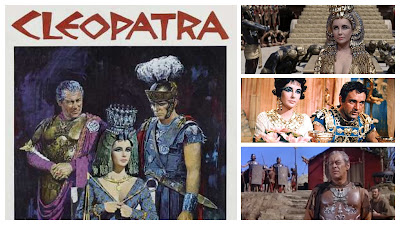


This week in history, in 30 BC, Cleopatra VII, Queen of Egypt, committed suicide. The famed historical figure has been the subject of several books, TV series, and films…with the most famous of all being Joseph L. Mankiewicz’s colossal epic from 1963. 


Cleopatra (Elizabeth Taylor), manipulates Julius Caesar (Rex Harrison), and years later, Mark Antony (Richard Burton), in an attempt to save Egypt from the rule of Rome. 


Directed by Joseph L. Mankiewicz and based on the book by Carlo Maria Franzero, CELOPATRA unfolds over the course of several years. The first half (before the intermission), focuses on Cleopatra and Caesar, with their budding relationship running parallel to their ambitions of rule. The second half, taking place after Caesar’s death and the birth of their son, deals with Cleopatra being pursued by Caesar’s old friend Marc Antony…who wants to build an army in Egypt to ward off a possible threat posed by Caesar’s nephew, Octavian (Roddy McDowall). 


The threat of war and Egypt falling under the rule of the expanding Roman Empire hangs over Cleopatra and her kingdom, but the film keeps things intimate at all times; ever does it keep its scenes in the indoor bathhouses, throne rooms, and bedrooms. The films’ politics and battles of love-interests gives the film more drama than action, and with a running time of over four hours, it feels every bit of its epic label. 


Up until 1993, CLEOPATRA was the most expensive film ever made, and every last cent can be seen on the screen. The sets are breathtaking with remarkable depth-of-field and scale, and every one of Elizabeth Taylor’s 65 costumes are stunning. The few battle scenes are staged in impressive ways even by today’s standards, and the quieter scenes keep moving with dialogue that is surprisingly witty and funny. The highlight of the film is Cleopatra’s spectacular entrance into Rome as she rides into the Roman Forum aboard a giant Sphinx surrounded by dancers. 


Elizabeth Taylor is excellent as Cleopatra; showing strength and vulnerability and is gorgeous to look at. Rex Harrison and Richard Burton are also very good. Roddy McDowall is surprisingly good as a bad guy, and smaller roles are held down well by Martin Landau and Carroll O’Connor (!). 


Anyone who knows their history (or read the first paragraph of this blog), knows how Cleopatra’s story will tragically end. The presentation of her end is done tastefully, and its impact can be felt as it is well-earned. CLEOPATRA is one of those films that can be put into the category of “they don’t make ‘em like that anymore”, with its massive sets, endless headcounts of extras, and preference of quiet drama over action. It’s an undertaking to watch, but this Queen deserves no less. 


BOTTOM LINE: See it. 


*


Reel Facts: CLEOPATRA would be nominated for nine Oscars, including Best Picture, and would win for Art Direction (color), Cinematography (color), Visual Effects, and Costume Design. The film’s production had several delays due to illnesses suffered by Elizabeth Taylor, with filming beginning in September 1960 and ending July 1962. 


Wednesday, August 25, 2021

A Reel 40: AN AMERICAN WEREWOLF IN LONDON

“Stay on the road, Keep clear of the moors.”


This month marks the 40th anniversary of John Landis’ horror/comedy, AN AMERICAN WEREWOLF IN LONDON. 


The hairy beginnings of AMERICAN WEREWOLF go back as far as 1969, when a young John Landis was working as a production assistant on KELLY’S HEROES in Yugoslavia. There, Landis observed a group of gypsies performing a ritual during a burial to prevent the body from rising from the grave. Inspired, Landis developed his idea into a script about two American backpackers in Northern England who are attacked by a werewolf, with one surviving with the terrible curse every full moon, and the other doomed to walk the Earth undead until the curse is lifted. 


Nothing came of Landis’ script for over a decade, and he went on to direct hits such as ANIMAL HOUSE (1978), and THE BLUES BROTHERS (1980). Although most studios considered the WEREWOLF screenplay, which was a blend of horror and comedy, to be too scary to be a full-blown comedy, he eventually secured a deal with PolyGram Pictures to bring the wolf to the screen. 


Filming would take place on location, with David Naughton playing David; the young man who is bitten by the wolf and transforms into the creature every full moon. Griffen Dunne plays his friend who is killed, and comes back from the grave with a warning for David; kill yourself and end the bloodline. The lovely and talented Jenny Agutter plays a nurse who falls in love with David. Makeup and visual effects were handled by Rick Baker, and Elmer Bernstein provided the score. The film’s soundtrack also featured pop-hits with “moon” in the title, such as Blue Moon, Moondance, and Bad Moon Rising. 


AN AMERICAN WEREWOLF IN LONDON was a critical and box office hit, earning $62 million worldwide against its $5 million budget. It would win the first-ever Academy Award for Best Makeup, along with the Saturn Award for Best Horror Film. Today, it is considered a milestone in the horror/comedy genre and for its innovative makeup effects. 


*


The history books may label AN AMERICAN WEREWOLF IN LONDON as a hybrid of horror and comedy, but this Blogger, like many others, find the film to be a true horror classic. Yes, it has some dry humor, humorous exchanges, and a quirky situation or two…but the horror elements outweigh all of that. From the startling transformation scenes, to the unsettling nightmares, to the horrific makeup done on the mauled bodies of the walking dead, to the foreboding atmosphere, John Landis delivers a film full of terrors. The humor balances it out and the film never takes itself too seriously as there is a self-awareness that grounds it. After 40 years, this wolf has lost none of its bite. 


“Beware the moon, lads…”


Monday, August 23, 2021

A Reel Retro Review: TO CATCH A THIEF (1955)

Reel Speak’s Retro Reviews will randomly review a classic film from the TCM library every week, with the intention of introducing some overlooked and perhaps forgotten screen gems from the past to those of us who may be unfamiliar or unawares of their existence. 


When the name of Alfred Hitchcock is mentioned, most of us relate the legendary filmmaker to his classic hits such as VERTIGO (1958), NORTH BY NORTHWEST (1959), and PSYCHO (1960). One of his often-overlooked works is his 1955 romantic thriller, TO CATCH A THIEF. 


Retired jewel thief John “The Cat” Robie (Cary Grant), is suspected of being behind a new string of burglaries in the French Rivera. Robie sets out to clear his name by catching the new thief, and follows the trail to a rich widow and her daughter Frances (Grace Kelly). 


Directed by Hitchcock and based on the 1952 novel of the same name, TO CATCH A THIEF has a sprinkle of the eventual GODFATHER line, just when I’m out, they pull me back in. Robie is living in a quiet retirement when the suspect him of being behind the new crime wave of high-priced diamond and jewelry thefts, and to clear his name he has to go back into his old underworld dealings to track down the thief. There is a lot of second-guessing going on, as for most of the film we are not quite sure if Robie is really behind the thievery or not. Mixed in with the mystery is the budding love affair between Robie and Frances. Although the two seem to fall for each other way too quickly, the on-screen couple gives the film some heart, and offers Robie a glimpse of what his life can really be like in the legitimate world. 


While Hitchcock is weaving a love story and mystery, he is also presenting a beautiful looking film. Shot on location, everything looks stunning and Hitch takes full advantage of every lake, mountainside, and villa. The “master of suspense” delivers in generating thrills, with plenty of hide-and-seek moments that work very well even by today’s standards. Hitch also gets fine performances out of his cast, with Cary Grant and Grace Kelly lighting up the screen. 


TO CATCH A THIEF ends on a high note, and although the overall experience doesn’t bring the high-level of scares and tension like VERTIGO or PSYCHO, by the time the credits roll there is no feeling of time wasted. The identity of the person behind the robberies is telegraphed early for anyone who is paying attention, but that doesn’t take away from another solid entry in the filmography of a legend. 


BOTTOM LINE: See it 


*


Reel Facts: TO CATCH A THIEF would be nominated for three Oscars, with Robert Burks winning for Best Cinematography. This would be the last of Hitchcock’s three films with Grace Kelly, and his second-to-last with Carey Grant, who would be the lead in NORTH BY NORTHWEST in 1959.


Wednesday, August 18, 2021

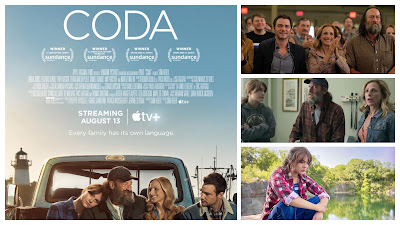
A Reel Review: CODA


As previewed by Reel Speak last week (HERE), Sian Heder’s family drama CODA has been earning attention for being the first of its kind; the film about the only hearing member of a deaf family was released in theatres and on Apple TV with full-captions…a major step towards including the hearing-impaired into cinema. Being innovative and opening doors is important, but no matter how well that is done, the film still has to deliver. 


Seventeen-year-old Ruby (Emilia Jones), is the only hearing member of her family, which includes her father Frank (Troy Kotsur), her mother Jackie (Marlee Matlin), and her brother Leo (Daniel Durant). When Ruby’s talent for singing is discovered by her choir teacher Mr. V. (Eugenio Derbez), Ruby must decide between a possible scholarship and supporting her family. 


Directed by Sian Heder and a loose remake of the 2014 French film LA FAMILLE BELIER, CODA is a family drama that carries several different genres; it’s a coming-of-age tale, weaved with a high school drama, working-class problems, and of course…the struggle for the hearing-impaired to survive in today’s fast-moving and complicated world. Ruby’s family relies on her heavily; to listen and translate via sign-language for them in simple every-day dealings such as keeping their fishing boat/business afloat and in doctor’s visits. The near over-reliance the family has on her makes her decision to apply for a music scholarship at prestigious Berklee all the more difficult. 


While Sian Heder is weaving many storylines at once, she manages to tell the story of the hearing impaired in funny, innovative, and emotional ways. The manipulation of sound only happens here and there, with one powerful moment in the third act that has to be seen (and not heard) to believe. The film does not rely on pity or patronizing, but instead focuses on the family and all of the love, resentment, uniting, and arguing that any family would have. 


Filmed on location in Gloucester, Massachusetts, the film looks gorgeous and neatly captures the grittiness of the working fishing community. American Sign Language (ASL), makes up half the dialogue…which is witty, funny, and powerful in each scene. Music selections, most of which are sung by Ruby, are perfectly chosen for the scenes and overall situation she finds herself in. 


Acting is tremendous. Emilia Jones spent nine months learning ASL and taking voice lessons and it shows; her voice is powerful and full of soul, and her ability to turn on the tears is stunning. The film benefits greatly by having actual hearing-impaired actors in the role of the family, with Troy Kotsur, Daniel Durant, and Marlee Matlin all excellent. The show is nearly stolen by Eugenio Derbez as the strict, yet nearly-flamboyant choir teacher who is a laugh a minute. 


As expected with a film like this, the finale is an emotional wallop that is sure to bring the tears while being uplifting, but it is executed in a simple way that avoids any cliches. CODA is a landmark film not just for its inclusiveness of the hearing-impaired, but also for its gentle and brilliant touch that opens those doors wide for the rest of us to see through; making this the true definition of an inclusive film. From its breathtaking opening shot to its final, emotional frame…CODA delivers and transcends. 


BOTTOM LINE: See it 


Wednesday, August 11, 2021

Reel Facts & Opinions: Let's Hear it for CODA


There is a lot of talk about inclusion and progress in Hollywood these days. People of color and minority groups are finally crossing over doors that were often closed to them; directing and starring in major productions and hopefully drawing people to their works who would otherwise not be. 


One group of people that has always struggled in the movie theatre are the hearing impaired. Captions are limited, and the issued glasses, headphones, and transmitters don’t always work or at least not well enough for a deaf person to enjoy the big-screen experience with everyone else. Speaking from experience, this Blogger worked as a projectionist for Cinemark theatres for nearly a decade, and although our gear was well-maintained, there always seemed to be an issue with our blasted headphones. 


But a major leap forward is happening this week with the new film, CODA. The drama film about the only hearing member of a deaf family will arrive with open-captions in all U.S. and U.K. theatres when the curtain rises this Friday. It will also be streamed with full subtitles in nearly 40 languages on Apple TV+. Apple worked with theatres to ensure the film would be played everywhere with the captions burned into the print, which is thought to be a first for a feature film. 


The idea could not be implemented into a better story. CODA follows 17-year-old Ruby (Emilia Jones), who interprets for her deaf father, mother, and brother…in all aspects of their lives including their fishing business and doctor’s visits. The family communicates with sign language with all of the deaf characters being played by deaf actors. The film has been a success so far; winning four awards at the famed Sundance Film Festival this year. 


CODA, which is an acronym for a child of deaf adults, follows on the heels of last year’s SOUND OF METAL, which was about a drummer who lost his hearing and earned six Oscar nominations. By presenting the film with open captions, CODA is opening the doors wide for those who would usually not make it past the lobby; which is the way it should be because movies should be welcoming for all. And that certainly isn’t limited to patrons. CODA is an excellent example of why it’s important that non-able-bodied actors should have the opportunity to play characters that represent them. To have a hearing-actor play a deaf character is one thing, but now we’re moving into a new generation of actors, filmmakers, and viewers. When the movies find a way to be for everyone, that is progress. 


*


Special thanks to Suzanne Crandall, friend of Reel Speak, for bringing this film to my attention. 


Monday, August 9, 2021

A Reel Retro Review: GAWAIN AND THE GREEN KNIGHT (1973)


David Lowery’s masterful adaptation of the classic, 14th century poem Sir Gawain and the Green Knight is currently in theatres (read Reel Speak’s review HERE). The tale of knighthood and chivalry has been adapted for the stage and screen numerous times over the years, with the very first attempt at the big screen coming in 1973. 


The Green Knight (Nigel Green), challenges any knight in King Arthur’s court to attempt to strike a blow on him, with the understanding that he may return it. Young squire Gawain (Murray Head), takes up the challenge, beheads the Green Knight, and then watches in horror as he places his removed head back on his shoulders…


Directed by Stephen Weeks, GAWAIN AND THE GREEN KNIGHT is composed of a series of adventures by Gawain, as he heads out to find the Green Knight’s hidden chapel to complete the deal. It’s episodic as Gawain has random up and downs, including a love affair with Linet (Ciaran Madden), who pops in and out of the story just as randomly as the adventures come. 


Weeks plays it loose with the original text, and only gets Gawain from place-to-place in broad strokes. The film seems to be more concerned with getting Gawain from here-to-there than with the deeper meanings that we would expect from the story; the true meaning of chivalry, honor, and what it is to be a Knight are glossed over. It’s a thin story that barely scratches the surface. 


Shot in the lush country-sides of Wales and Cornwall, the film looks great for its time when things are outdoors. However there is a bland cheapness to everything when it moves indoors or for closeups. The costumes and hairstyles are cliched to the point that it looks like a renaissance fair or Halloween party, and the interior castle rooms and walls are barely decorated or filled in. Visual effects are crap even for 1973, and continuity problems are everywhere (the size of the Green Knight’s axe changes from shot-to-shot). The fight scenes are very well done, but the cast members blurt out the dialogue as if they are reading from cue-cards. 


GAWAIN AND THE GREEN KNIGHT runs a tight 93 minutes, but it feels longer which is never a good thing. The effort is earnest, but the lack of any real depth to the script and the shallow budget really shows. This is an example of how not to the tell the famous story. 


BOTTOM LINE: Fuck it 


Reel Facts: Stephen Weeks would take another shot at the story in 1984 as SWORD OF THE VALIANT, with Sean Connery as the Green Knight. The 1973 film would be the final appearance for Nigel Green, who played Hercules in the 1963 adventure film, JASON AND THE ARGONAUTS. 


Friday, August 6, 2021

A Reel Review: THE SUICIDE SQUAD


In 2016, Warner Bros. brought us the David Ayer-directed, DC Comics super-villain team-up film SUICIDE SQUAD, which finished as one of the most dysfunctional movies of all time. How bad was it? Bad enough that Warners decided to pretend it never happened, and to bring us a new version; this time directed by James Gunn and re-titled THE SUICIDE SQUAD. 


U.S. Government Intelligence Officer Amanda Waller (Viola Davis), recruits and blackmails a team of assassins and criminals out of prison to overthrow an anti-American regime in a South American island. The team is led by Col. Rick Flag (Joel Kinnaman), and includes (but not limited to), the master-assassin Bloodsport (Idris Elba), the gung-ho sniper Peacemaker (John Cena), a human-hybrid shark (voiced by Sylvester Stallone), a vengeful human experiment gone wrong called Polka-Dot Man (David Dastmalchian), a young woman called Ratcatcher 2 who controls rats (Daniela Melchoir), and the slightly-insane legendary criminal Harley Quinn (Margot Robbie). 


Seemingly aware of the endless introductions and exposition that plagued the first attempt at this property, James Gunn puts the petal down hard in the opening minutes; offering very little setup which is then followed by half of the Squad getting wiped out. It’s a jarring, awkward beginning, which is only justified after the narrative goes backwards for the required set-up; a tool that the film uses often. From there, the remaining members of the team are split up (so much for the Squad), and the film moves into a series of episodes as they move closer to their goal.


The story is thin, so THE SUICIDE SQUAD relies on its many characters to keep things moving. The Squad is a bunch of oddballs with odd personalities, and Gunn peppers them with his witty writing and one-liners. There are many laughs to be had in dialogue and visual gags, and a fair amount of fun. The film tries really hard to avoid the dourness that most DC Comics films are known for; in fact, too hard as eventually the humor moves into juvenile territory. Overall, the entertaining characters just don’t elevate the plot as much as they need to. 


Gunn does a fair job in keeping the energy levels high. The action scenes are done very well although some of them go on for way too long. The film is a bloodbath with bodies blowing up all over the place. Eventually more plot is stuffed in with the real, secret reason why the Squad was sent to this island, and it reveals another big bad villain which is funny at first but overstays its welcome and becomes utterly stupid. 


Acting is all over the place. Idris Elba gets most of the heavy lifting and does well, even though he has very little to work with. The great Viola Davis is shortchanged as all she does is play angry for no reason. Margot Robbie is once again a delight as Harley Quinn, but her character is one-note, and they seem to be (again), trying to hard to make the character into a hero. Daniela Melchoir is excellent, and John Cena is a blast. 


The question everyone wants answered is; is it better than the first version? It is, but that isn’t saying much. THE SUICIDE SQUAD is definitely more coherent and more fun, but its over-reliance on gags and blood, thin characters, and a weak plot that doesn’t make the mission worth the 132-minute run-time only makes it a tad better. Maybe the third crack at it will deliver something more than a few laughs. 


BOTTOM LINE: Rent it 


Wednesday, August 4, 2021

A Reel Review: THE GREEN KNIGHT


Over the last eight years, writer and director David Lowery has established himself as one of the best, deep-thinker filmmakers working today; starting with his crime drama AIN’T THEM BODIES SAINTS (2013),  his supernatural mind-bender A GHOST STORY (2017), and his introspective heist film, THE OLD MAN AND THE GUN (2018). Here in 2021, Lowery takes on the 14th-century poem Sir Gawain and the Green Knight in his epic medieval fantasy, THE GREEN KNIGHT. 


It is Christmas in King Arthur’s court when the mysterious Green Knight appears, and lays down a challenge; any knight who lands a blow on him will be allowed to keep his mighty axe, but in one year’s time, the Green Knight will return the same stroke. Eager to impress the court, young squire Gawain (Dev Patel), beheads the creature, only to watch in amazement as he picks up his head and rides off…


THE GREEN KNIGHT is simple; find the Green Chapel where the knight resides, and allow him to return the chop across the neck. It’s a bare-bones story that David Lowery presents in an episodic manner, with Gawain encountering dangers and friends along the way. These include armed bandits, stone giants, seductive ladies, beheaded ghosts, and a talking fox…among others. Each encounter seems to reflect a part of Gawain, and his simple quest to complete his word and retain honor is entangled with his learning of what it really means to be a knight. 


Lowery, as he’s done in his past works, uses the medieval genre as a backdrop and uses his characters as a study of deeper issues. Gawain’s ideas of honor are challenged and explored, and as a bit of a bewildered fool…he is as clueless as the audience in the many strange happenings. THE GREEN KNIGHT has a dreamlike, ethereal feel to it…often crossing the lines between fantasy and reality. 


The film unfolds slowly with an incredible build of atmosphere. Simple tasks such as a boat crossing and a lightning storm are harrowing without beating us over the head. Lowery’s camera is always meticulously framed; every shot is a painting and there are several unbroken, long tracking shots which have to be seen to be believed. One highlight of the film comes late, when Gawain has a long glimpse of what his future holds if he fails in his task; a glimpse that comes about in a 15-minute sequence with no dialogue.  Daniel Hart’s score is astounding. 


Dev Patel puts in his career-best performance; ranging from emotional to physical. The strong cast supports him well. Alicia Vikander has two roles; one of Gawain’s brothel-friend and the other a mysterious lady. Joel Edgerton pops in and makes an impression. King Arthur is played by Sean Harris and is excellent. 


There is a lot in THE GREEN KNIGHT that might not make sense on a first viewing, but allowing it to sit, and repeat viewings will reveal more each time. David Lowery has crafted a masterpiece here; one that provokes thought while stunning the senses. 


BOTTOM LINE: See it 


Friday, July 30, 2021

A Reel Review: JUNGLE CRUISE


In 1955, Walt Disney opened his still-popular Jungle Cruise attraction. Taking inspiration from the hit film THE AFRICAN QUEEN (1952), the ride took wanna-be young explorers on a steam-boat through an exotic jungle, encountering dangerous and beautiful wildlife. Here in 2021, the ride comes back full circle to its cinematic roots.


At the outbreak of WWI, Dr. Lily Houghton (Emily Blunt), along with her brother MacGregor (Jack Whitehall), hire steamboat skipper Frank Wolff (Dwayne Johnson), to take them down the Amazon river in search of the fabled Tree of Life; which is believed to have special healing powers that could revolutionize modern medicine. 


Directed by Jaume Collet-Serra, JUNGLE CRUISE is a rollicking adventure up and down the river; seeing our jungle explorers endure the sweltering heat, headhunters, pirhanna, and a German submarine captain (Jesse Plemons), who wants the secret of the Tree of Life to aid Germany’s cause in the new World War. 


There is a lot of fun to be had as the little steamboat evades torpedoes and navigates treacherous waterfalls and rapids, but JUNGLE CRUISE still manages to be character-driven. Lily is a scientist who wants a way to heal the wounded soldiers, and is more than capable of handling herself outdoors and in a fistfight. Her brother is a well-to-do gentleman who just wants to support his sister but is a fish out of water in the jungle. Frank the skipper is just out to make money and keep floating, although he does have a few secrets of his own. The clashing characters keep things grounded and fresh in all of the chasing, fighting, and evading. 


Director Jaume Collet-Serra, who is known for directing horror films along with a handful of Liam Neeson-led action duds, maintains a well-paced, high-energy film…which is balanced out nicely by well-timed intimate character moments. The action scenes, chases, and fights are a blast…and he keeps his horror-film roots in play with a few great jump-scares and creep-out moments. Visual effects are top-notch, and the film looks gorgeous. JUNGLE CRUISE stays very true to its origins; working in clever winks to THE AFRICAN QUEEN and the original ride; long-time fans of the original attraction will find a lot to cheer about. The score by James Newton Howard is excellent. 


Acting is electric as the entire cast seems to be having a blast. Emily Blunt is a delight as always. Her character seems a little undercooked as her Dr. Lily has little motivation to heal wounded soldiers other than in the name of science, but Blunt carries it well and makes it work. She does a lot of physical work here while lighting up the screen every time she’s in frame. Her chemistry with Dwayne Johnson lights things up even more, and Jack Whitehall provides comic relief and a surprising amount of heart. 


Many film fans will find cause to compare JUNGLE CRUISE to THE MUMMY from 1999, and that’s perfectly fine…because like THE MUMMY, this new Disney production is a high-energy, well-acted, great-looking, old-school adventure saturated in film lore. Take this cruise and enjoy. 


BOTTOM LINE: See it 


Wednesday, July 28, 2021

A Reel Review: OLD


M. Night Shyamalan, the once-heralded director of hits such as THE SIXTH SENSE (1999), and SIGNS (2002), has certainly taken his fair share of socks on the jaw in the last 15 years. One of the unfair blows he takes is the thought that his movies should be judged by the expected “twist” ending; if the twist is not a mind-blower, then the movie is a dud. This is true to an extent, because there’s more to a film than just a twist…but at the same time…M. Night has a tendency to pack much of his stories into that final reveal. 


Married couple Guy and Prisca (Gael Garcia Bernal and Vicky Krieps), book a vacation to a tropical resort with their children Trent (Nolan River), and Maddox (Alexa Swinton). They are encouraged to visit a private beach, where, along with a few other couples and vacationers, discover that the beach is making them all age rapidly. 


Loosely based on the graphic novel Sandcastle by Pierre Oscar Levy and Frederik Peeters, OLD is a closed-quarters horror-thriller where rapid aging brings about terror and fascination. The kids become teens within hours, and the adults lose their eyesight, hearing, and find their pre-existing medical conditions also advancing. It’s a mish-mash of science and fantasy, with the film often going out of its way to stop the proceedings to make sure what is happening is explained. 


OLD seems to take a page out of the closed-quarters classic film 12 ANGRY MEN (1957) in isolating people of all walks of life and letting conflict do its thing. The group ranges from a famous rapper, a doctor with mental issues, and a woman with epilepsy. The situation generates a lot of bickering between them all, which doesn’t get as annoying as it could have. M. Night seems to have a grasp on the human condition in how people react to extraordinary circumstances, and the cast carries it all very well. 


OLD may ultimately land as M. Night’s best-shot film. His fluid camera movement hides and reveals things in clever ways, and the beach, ocean, and surroundings look gorgeous. He generates some genuine horrific moments and some excellent scares. Some of his dialogue is clunky and too on-the-nose (I can’t wait to hear you sing when you’re older, I have a spare bathing suit in my bag), which exists to foreshadow events and to explain away rapidly growing kids. 


The cast overall does very good work. Gael Garcia Bernal and Vicky Krieps are excellent, but the film is stolen by Thomasin McKenzie, who plays Maddox as a pre-teen. 


So let’s talk about that twist. It isn’t a twist as much as a reveal; just a simple pull-back of the curtain to see the wizard pulling all the levers. It makes sense, and any possible hole in the concept is filled in, even if the characters have to blurt it out. It isn’t a mind-blower, but it works. But OLD does stumble in the final five minutes; there was a natural, easy spot to end the film, but M. Night hangs around for what seems like endless minutes over-explaining and over-working to wrap things up. There is little for the audience to fill in for themselves, and one has to wonder if the Twitter-age of needing everything spelled out in a road-map had an influence. In this case, it isn’t the twist that deducts points for M. Night, but what happens after. OLD is a neat little film that just needed to trust its audience more. 


BOTTOM LINE: Rent it